
Description
THE TENDON IN PRACTICE
A Complete Toolkit for Treating a Sore Tendon
In college, you may have heard that if an area hurts, you need to Massage it, roll it out, stretch it, and wait until the pain goes away.
But what happens next?
Because your patient doesn't want to be good at lying on the table.
He wants to run again. Work out at the gym. Play soccer. Get back on the tennis court. Or just get back to the activities he enjoys.
Just reducing the pain doesn't solve the problem.
You need to prepare the tendon and your entire body once again for the stress it will have to endure during training and normal activities. The article explains that this is the foundation of the entire process—from finding a tolerable workload to gradually returning to running, jumping, and training.
And this is often where the questions begin.
What should I do first?
How do you choose the right weight?
When can you do more?
When should you stay at your current job?
When should you back up?
When should you start a more intense workout?
When should you start running and jumping?
And how do you know when it's safe to move on?
That is exactly why it was created The Tendon in Practice.
This is a comprehensive toolkit for coaches and physical therapists who want to structure their work with individuals experiencing tendon pain—from the initial assessment of the problem, through strength training and monitoring of responses, all the way to a return to sports or physical activity.
YOU DON'T NEED ANOTHER LIST OF EXERCISES
The exercise itself doesn't tell you:
Is it appropriate for this person,
what dose to use,
when to increase it,
or when to move on to the next stage.
That's why this package wasn't created just to give you another 50 exercises to write down.
It's meant to help you organize the process.
From:
„It hurts—what now?”
To:
„I know what I'm looking for, what kind of work I'm bringing to the table, and how I'll determine whether we can take the next step.”
WHAT'S GOING TO CHANGE IN YOUR JOB?
After going through the materials, you'll not only know more about training options.
Do you have make future decisions with greater confidence.
Instead of:
„The pain is less, so I guess we can do a little more.”
I want you to think:
„I can see how this person is reacting. I know what I want to achieve at this stage and what I need before moving on to the next step.”
Instead of focusing only on the source of the pain, you start to look at the entire process:
symptoms → exercise tolerance → strength → dynamic exercise → running and jumping → return to activity.
In Frame, each phase involves asking exactly these kinds of questions: What is the goal? What does the work look like in practice? And how do you know when it’s time to move on?.
WHAT DO YOU GET?
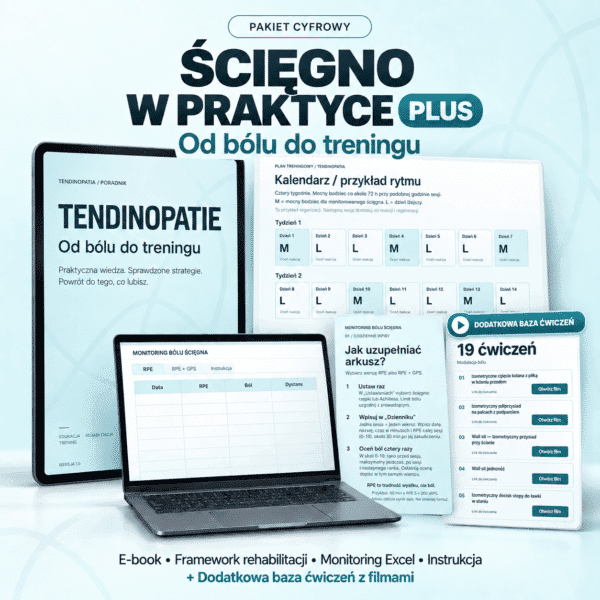
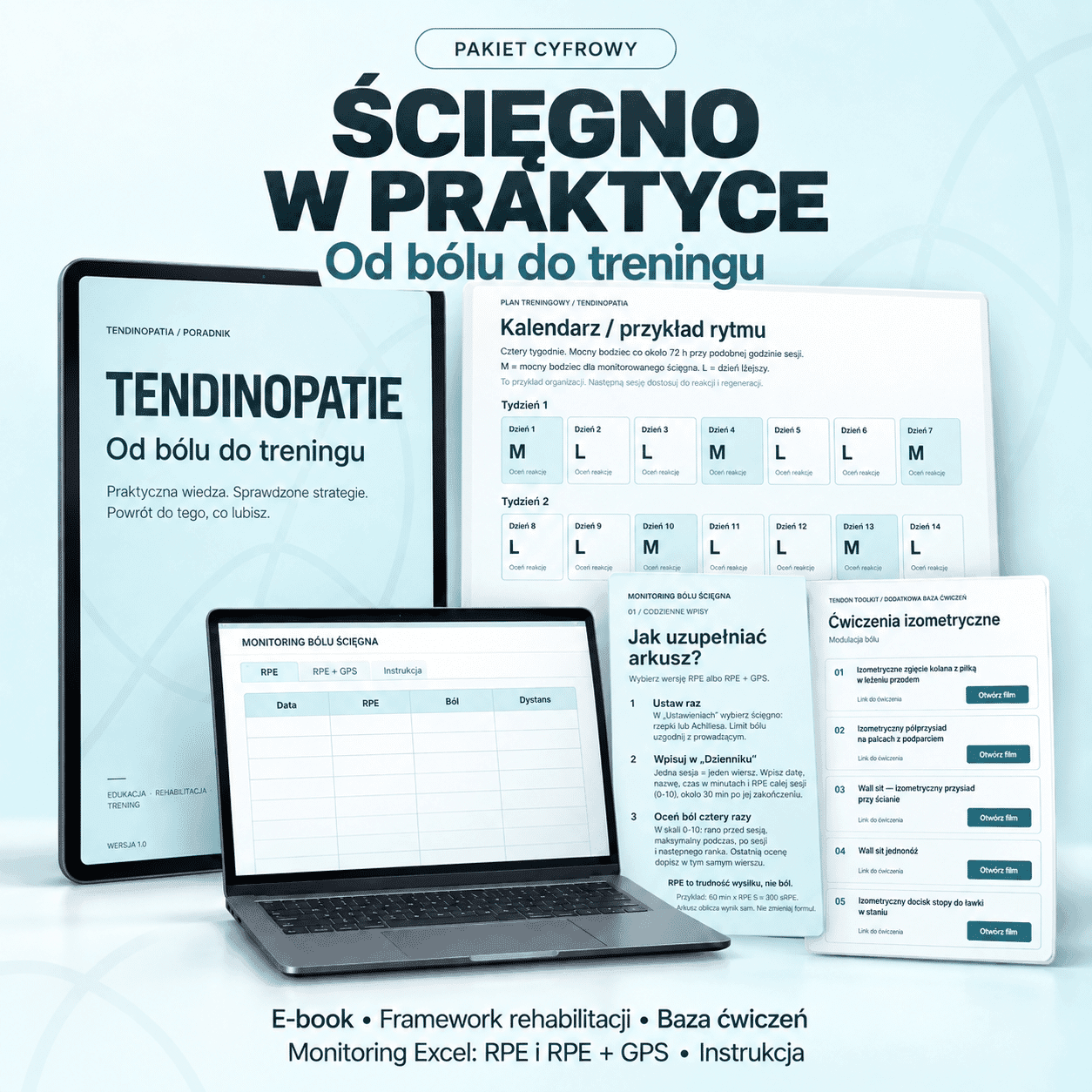
1. „FROM PAIN TO TRAINING” GUIDE”
First, let's go over the basics.
This material helps you understand, among other things:
- Why doesn't every kind of pain indicate the same problem,
- how to think about load capacity,
- how to use isometric projection,
- how to respond to an increase in symptoms,
- Why does a decrease in pain alone not necessarily mean the work is done,
- How to gradually increase your training intensity.
The guide also begins with an important distinction: First, you need to determine the cause of the symptoms, and only then should you choose the appropriate dosage and exercises.
2. TENDON FRAME
This is the practical framework for the entire process.
I'll show you how to structure your work, starting with less demanding tasks and gradually moving on to more challenging ones.
There you'll find:
- an example of how to organize the subsequent stages,
- days that are harder and days that are easier,
- examples of training units,
- exercises,
- sets and repetitions,
- pace,
- breaks,
- tips,
- Examples of progression criteria.
This isn't a protocol that you copy exactly for every person.
This decision-making framework, which you tailor to a specific person.
In the article itself, I emphasize that the exercises, intensity, and pace of progression must be adjusted based on the athlete’s or patient’s response.
3. PAIN AND STRESS MONITORING SHEET
Because memory:
„I think it hurt a little less yesterday.”
It's a poor monitoring system.
In the spreadsheet, you can record:
- training time,
- RPE,
- anxiety before the exam,
- the most pain during,
- post-workout pain,
- the reaction the next morning.
The worksheet helps you connect what a person did, and how they reacted afterward.
You also get a version RPE + GPS, where you can also track metrics such as distance, HSR, sprints, acceleration, and braking.
4. INSTRUCTIONS FOR THE WORKSHEET
You don't have to figure out how Excel works on your own.
You'll receive simple instructions:
- what to set,
- what to enter,
- When to assess pain,
- how to record RPE,
- how to read the result.
Statuses help you quickly identify situations where you can stick to your planned workload, when it’s better not to increase your workload just yet, or when it’s worth reducing it.
YOU DON'T HAVE TO WAIT UNTIL YOU'VE READ EVERYTHING
Do you have a patient with a sore tendon coming in tomorrow?
You can start using the tools right away.
Open Frame.
Find out where that person is right now.
Start monitoring.
Start gathering information about your workout and pain response.
Go to the appropriate section of the guide.
Find out what factors you should consider.
Plan your next step.
The first result does not necessarily have to be the completion of the entire process.
The first result could be:
„I know what I want to check on my next visit and what I need before the next progression.”
YOU DON'T HAVE TO BUILD THIS FROM SCRATCH
You don't have to create it yourself:
- monitoring system,
- RPE worksheet,
- the method of recording pain responses,
- the structure of the subsequent stages,
- training unit cards,
- sample workouts,
- criteria that will help guide future decisions.
I've done a lot of this work for you.
You still need to assess each individual, select the appropriate workload, and make decisions within the scope of your authority.
But you don't start every case with a blank page.
Do you have tools, framework, and examples, which you can refer back to in your day-to-day work.
WHO IS „THE TENDON IN PRACTICE” FOR?
For physical therapists and trainers, who work with active individuals.
Whether it's an athlete who wants to return to the field or someone who wants to once again:
- run,
- work out at the gym,
- play for fun,
- return to the court,
- or simply enjoy your favorite activity without any worries.
Especially if:
- You handle pain well, but you don't always know what to do next,
- You know a lot of exercises, but you don't have a clear way to organize the process,
- Are you wondering when to increase the load,
- Do you want to better track your response to training,
- Do you want to combine your work at the office with strength training and getting back to being active,
- You don't want to end the process at the sentence „It doesn't hurt anymore.”.
BECAUSE „IT DOESN’T HURT ANYMORE” IS ONLY PART OF THE JOURNEY
For one person, the goal will be to get back in the game.
For another, a 10-kilometer run.
Next up: back to the gym or the tennis court.
It's not enough to just relieve the symptoms.
We also need to prepare people for what they want to do later on.
THE TENDON IN PRACTICE
A complete toolkit for treating a sore tendon.
From pain. Through rehabilitation. Back to activity.